 Romwald

Editorial note: this guide is based on official USA Pickleball rules and published specifications. We do not claim hands-on lab testing of the paddle types described.
Choosing the wrong paddle is the fastest way to make pickleball harder than it needs to be. Too heavy, and your arm tires by the third game; too light, and every drive feels flimsy. This guide explains how to choose a pickleball paddle in six simple steps, without memorizing brand names.
Quick Answer: What Most Beginners Should Look For
If you want the short version before the details, start here. Most new players are best served by a forgiving, mid-weight paddle that prioritizes control over raw power.
- Shape: standard or widebody, for a larger and more forgiving sweet spot.
- Weight: mid-weight (roughly 7.3 to 8.4 oz) for a balance of power and control.
- Core thickness: 14 to 16 mm for control and forgiveness.
- Face: fiberglass or composite is usually kinder on price; carbon fiber adds feel and spin.
- Approval: make sure the model appears on the USA Pickleball approved list.
Step 1: Start With the Rules
Before you fall in love with a specific model, check that it is legal for the level of play you intend to enter. Under the current USA Pickleball equipment standards, a paddle cannot be longer than 17 inches, and the combined length and width cannot exceed 24 inches. There is no restriction on paddle thickness or weight.
Players are also responsible for confirming that their paddle is listed as “Pass” on the approved list when they play in sanctioned events. We cover that in detail in our guide to how approved paddle lists work. Rules change, so confirm the details in the current rulebook at USA Pickleball.
Step 2: Pick a Shape
Paddle shape changes where the sweet spot sits and how much reach you get. Every inch you add in length is an inch you lose in width, so this is a deliberate tradeoff.
- Standard or widebody: a balanced shape with the widest face and a large, centrally located sweet spot. This is the safest starting point for beginners and doubles players who live at the kitchen line.
- Elongated: longer and narrower, with extra reach and leverage on drives and serves. The tradeoff is a smaller sweet spot, so off-center hits are less forgiving. Best for singles players or those with developed technique.
- Hybrid: splits the difference between standard and elongated, offering more reach than a standard without sacrificing too much forgiveness.

Step 3: Choose a Weight You Can Swing All Day
Lighter paddles are easier to maneuver in quick exchanges at the net but give you less power on drives. Heavier paddles add stability and pop but can tire your arm over a long session. Mid-weight paddles are the usual compromise for most recreational players.
Weight distribution matters too. A head-heavy paddle delivers more power, while a head-light paddle feels quicker in your hand. If you have arm or elbow sensitivity, lean lighter and prioritize a forgiving core over power.
Step 4: Understand Core Thickness
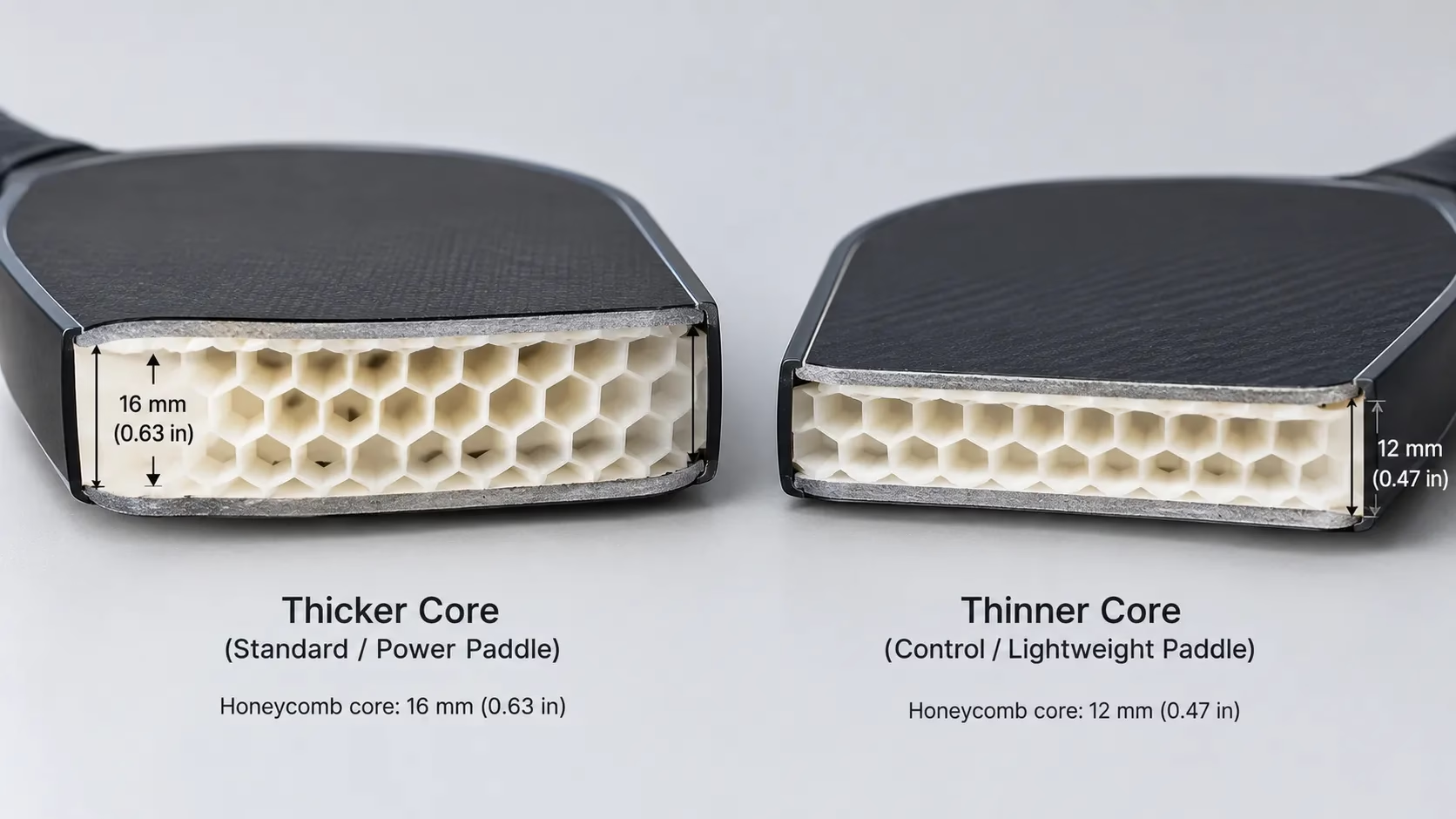
Most modern paddles use a honeycomb-style polymer core. Thicker cores generally give more control and a softer feel, while thinner cores tend to feel livelier and more powerful.
The two numbers that dominate buying guides are 14 mm and 16 mm, which is why those two figures appear in almost every guide. A 16 mm core absorbs more pace, creates a larger sweet spot, and makes dinks and resets easier to control. A 14 mm core rebounds faster, giving you more pop on drives and serves. If you are new, a 16 mm core is a forgiving place to start. If you already have solid technique and want more power, a 14 mm core is worth testing.
Step 5: Compare Face Materials
The face is where your hand meets the ball. Material affects feel, spin, and durability.
| Face material | What it tends to offer | Best for |
|---|---|---|
| Fiberglass / composite | Power and pop, usually lower price | Beginners and budget buyers |
| Graphite | Light, crisp feel and control | Players who like touch at the net |
| Carbon fiber | Firm feel, often a textured surface for spin | Improving players who want spin |
Surface texture can help with spin, but remember that equipment standards evolve. USA Pickleball rules restrict surface roughness and friction to prevent excessive spin. Always check the model against the current approved list before you buy.
Step 6: Check Grip Size
A grip that is too small invites a tight squeeze, and one that is too large slows your wrist. Most adult paddles come with a grip circumference of roughly 4 to 4.5 inches. If you are between sizes, choose the smaller one: you can always add an overgrip to build it up, but you cannot shrink a handle.
Smart Buying Tips
- Demo before you buy. Many clubs, shops, and local groups let you try paddles before committing.
- Do not chase the highest price. Mid-range paddles often deliver nearly all of what a new player can use. Technique matters far more than a premium price tag at the beginner level.
- Buy gear as a system. Our pickleball starter kit checklist shows what to buy first and what can wait.
- Learn the game. Once you have a paddle, brush up with our pickleball rules for beginners.
FAQ
Does a more expensive paddle make me a better player?
Not by itself. Technique, footwork, and consistency matter far more at the beginner and intermediate level. A well-matched mid-range paddle usually beats an ill-fitting premium one.
Is a thick or thin core better for beginners?
Most beginners do better with a thicker core (16 mm) because it is more forgiving and easier to control. A thin core (14 mm) gives more power but demands more precision.
Do I need a USA Pickleball approved paddle for casual play?
Approval is required for tournaments and matches played under USA Pickleball rules. Casual rec play is often more relaxed, but an approved model is the safest choice if you might enter events later.
The Bottom Line
Pick a standard or widebody shape, a mid-weight paddle, a 14 to 16 mm core, and an approved model. Then refine as your game develops. Want to see where the market is heading? Read our look at pickleball gear trends.
Related Reading
- Pickleball Paddle Approved List: Is Your Paddle Legal?
- Pickleball Starter Kit: Everything Beginners Need (and What to Skip)
- Pickleball Rules for Beginners: Scoring, Serving and the Kitchen
- Pickleball Gear Trends to Watch This Season
Last updated: October 2026.